Small Business Website Discoverability in 2026: Why Your Live Site Is Still Invisible
A recent report found that 58% of local service businesses remain invisible to ready-to-buy customers even though they have a live, functioning website. Think about that for a second. More than half of all small business websites are essentially parked on a street where nobody drives.
If you launched your website expecting it to bring in leads, and instead your phone stays quiet and your inbox stays empty, you are not alone. The way people find businesses online has changed dramatically. Google’s AI Overviews now answer questions before anyone clicks a link. Chatbots like ChatGPT and Perplexity recommend businesses directly. And social platforms like Instagram are becoming search engines of their own.
Small business website discoverability is no longer just about ranking on page one of Google. It is about showing up across a fragmented set of platforms, AI tools, and discovery channels that did not exist two years ago.
In this post, you will learn exactly why your website is invisible, which channels actually matter in 2026, and the specific steps you can take to fix it without blowing your budget. Let’s break it down.
What Does Small Business Website Discoverability Actually Mean in 2026?
Discoverability is no longer just about search engine rankings. It is the total ability of your website to be found, referenced, and recommended across every channel your potential customers use. That includes Google, yes. But it also includes AI assistants, voice search, social media, map apps, and industry directories.
Think of it like opening a restaurant. Ten years ago, if you put up a sign on a busy road and listed yourself in the Yellow Pages, people would walk in. Today, that road has ten lanes, half of them underground, and your sign only faces one direction. Your website needs to face every direction at once.
When clients come to us at Royce Web Solutions with this problem, the first thing we check is not their Google ranking. It is whether their website even exists in the places where their customers are actually looking. In our experience working with startups and small businesses, the answer is almost always no. The site is technically live but practically invisible.
Why Can’t Customers Find My Website Even Though It’s Live?
Your website might look great. It might even load fast. But if it is invisible, there are usually a few specific reasons hiding behind the scenes.
- The most common issue we see is incomplete or inconsistent business information. If your business name, address, and phone number appear differently on your website, your Google Business Profile, and your social media pages, search engines lose confidence in your data. They do not know which version is correct, so they show someone else instead.
- The second issue is poor content structure. Search engines and AI tools both need clear signals about what your site offers. If your pages lack structured headings, meta descriptions, or schema markup, you are essentially handing Google a blank business card.
- And then there is the technical side. Robots.txt files accidentally blocking crawlers. Missing XML sitemaps. Pages with noindex tags left over from development. These are small oversights that make your site completely invisible to search engines. A website that is not indexed does not exist as far as Google is concerned.
How Zero-Click Searches Are Stealing Your Small Business Traffic
Over 60% of Google searches now end without a single click to any website. That statistic from 2026 should alarm every small business owner. It means that even if your site ranks well, the majority of searchers never actually visit it because Google answers their question right on the results page.
These are called zero-click searches. Google pulls content from websites and displays it as featured snippets, knowledge panels, or map packs. The user gets what they need and moves on. Your site provided the information but received zero traffic in return.
For local businesses, this is especially painful. Searches like “plumber near me” or “best coffee shop in Irvine” trigger map results that show business hours, reviews, and directions. The customer calls directly from Google. They never see your website at all. Local intent searches produce up to 78% zero-click outcomes.
The fix is not to fight zero-click searches. It is to make sure your business owns the information that appears in those results. That means optimizing your Google Business Profile, adding structured data to your website, and building the kind of authority that makes Google choose you as the source.
What Are Google AI Overviews and Why Should Small Businesses Care?
Google AI Overviews are AI-generated summaries that now appear at the top of nearly half of all search results. When a user asks a question, Google’s AI reads multiple websites and writes a summary answer directly on the results page. When these summaries appear, clicks on traditional search results drop by up to 58%.
For a small business, this is a double problem. First, fewer people click through to your site. Second, if the AI does not reference your website as a source, you are losing both traffic and brand visibility at the same time.
We have seen this hit our clients’ sites directly. One e-commerce client noticed a 30% drop in organic traffic over three months without losing a single ranking position. The rankings stayed the same. The clicks disappeared because AI Overviews were answering the queries their blog posts used to attract.
Getting referenced inside an AI Overview requires a different approach than traditional SEO. Your content needs to be structured in clear, direct question-and-answer formats. Your pages need schema markup. And your site needs to load fast because websites with under two-second load times are 40% more likely to be cited by AI.
What Is Answer Engine Optimization and How Does It Help Your Website Get Found?
Answer Engine Optimization, often called AEO, is the practice of structuring your website content so that AI tools can read, understand, and recommend it. If traditional SEO is about ranking on Google, AEO is about being the answer that AI delivers to your customers directly.
This matters because 25% of organic search traffic is expected to shift to AI chatbots and virtual assistants by the end of 2026. When someone asks ChatGPT, Perplexity, or Google’s Gemini for a recommendation, those tools pull from websites that present information in a clean, structured, trustworthy way.
At Royce, we have started building AEO into every new website we create. The approach focuses on three things: First, reformatting content into clear question-and-answer sections that voice assistants can easily parse. Second, implementing Schema.org structured data so that AI tools understand what each page is about. Third, making sure your business information is consistent everywhere it appears online because AI tools cross-reference multiple sources before recommending a business.
If you are a small business owner wondering how to improve website discoverability 2026, AEO is no longer optional. It is the bridge between your website and the AI platforms your customers are already using.
5 Mistakes That Keep Your Small Business Website Invisible
We have audited hundreds of small business websites at Royce, and the same patterns keep appearing. Here are the five mistakes that silently kill your website visibility for small businesses.
1. Your Website Has No Clear Value Proposition Above the Fold
If a visitor cannot tell what you do and who you help within five seconds of landing on your homepage, they leave. And if they leave immediately, Google notices. That bounce signal tells search engines your page did not satisfy the query. Spell out your service, your audience, and your location in the first headline.
2. You Skipped Local SEO Entirely
If someone in your city searches for your service and you do not show up in the map pack, your website might as well not exist. Claiming your Google Business Profile, keeping hours updated, and collecting reviews are the minimum requirements for local discoverability.
3. Your Site Has No Schema Markup
Schema markup tells search engines exactly what type of content is on each page. Without it, you are relying on Google to figure it out on its own. Adding LocalBusiness, FAQ, and Service schema can immediately improve how your site appears in search results.
4. You Publish Content Without a Clear Search Intent
Blogging is great. But if your posts do not target specific questions your customers are asking, they will not rank. Every piece of content needs a clear keyword, a defined audience, and a reason to exist beyond filling your blog page.
5. Your Business Information Is Inconsistent Across the Web
If your address reads one way on your website, another way on Yelp, and a third way on your Google profile, search engines and AI tools lose trust. Consistency across every listing is what builds the confidence engines need to recommend you.
How to Actually Fix Small Business Website Discoverability in 2026
Fixing discoverability is not about one silver bullet. It is about building a system where your website gets found through multiple channels at the same time. Here is what actually works in 2026.
Start with your Google Business Profile. This is the single highest-impact action most small businesses skip. Make sure every field is filled out. Add photos weekly. Respond to reviews. Post updates. Google rewards active profiles with better placement in the map pack and local results.
Next, audit your website’s technical foundation. Check for indexing issues, fix broken links, submit an updated XML sitemap, and make sure your site loads in under two seconds. If you do not have the technical skills for this, working with a team that offers custom web development services can save you months of guessing.
Then, invest in structured content that targets real questions your customers ask. Use FAQ sections, how-to guides, and service pages that match the way people search. Add schema markup to every key page. This combination is what gets your site referenced in both traditional search results and AI-generated answers.
Finally, think beyond Google. Make sure your business is listed on industry directories, local chambers of commerce sites, and relevant social platforms. The more places AI tools can find consistent information about your business, the more confident they become in recommending you.
Real-World Example: How One Local Business Went from Invisible to Fully Booked
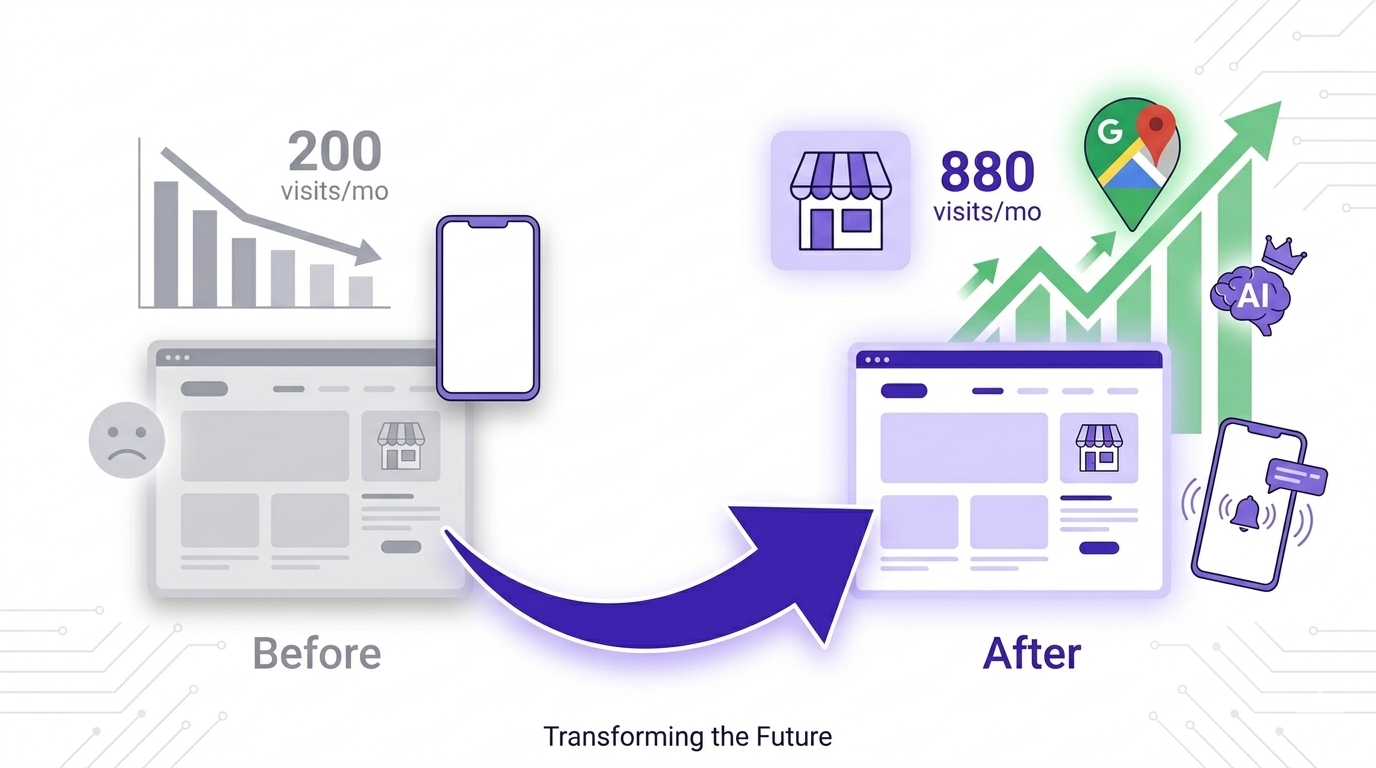
A wellness studio in Southern California came to us last year with a problem many small business owners will recognize. They had a beautiful website. It loaded quickly. It looked professional. But it was generating less than 200 visits per month and almost no inbound calls.
After our audit, we found the classic pattern. No Google Business Profile claimed. No schema markup on any page. Blog posts that targeted no specific keywords. And their business name was spelled differently across three listing sites.
We fixed the technical issues first, then restructured their content around the actual questions their customers were typing into Google. We added LocalBusiness and FAQ schema, claimed and optimized their Google Business Profile, and built out five location-specific service pages. You can see how we approach projects like this across our recent client work.
Within four months, their organic traffic grew 340%. Their phone started ringing from map pack appearances. And they were being cited in Google’s AI Overview for two of their most popular service queries. The website was the same design. The discoverability was completely different.
Does Your Website Need a Redesign or Just Better Visibility?
This is a question we get asked constantly. And the honest answer is: most of the time, you do not need a new website. You need a discoverable one.
Redesigns are expensive and time-consuming. If your current site is mobile-friendly, loads reasonably fast, and clearly communicates your services, the design is probably not the problem. The problem is that nobody can find it.
That said, there are situations where a redesign genuinely makes sense. If your site is not mobile-responsive, if it was built on outdated technology that cannot support schema markup or fast loading, or if the navigation confuses users, then investing in affordable web design for startups and small businesses will pay for itself quickly.
The key is to diagnose before you prescribe. Run a technical audit. Check your Google Business Profile. Review your indexing status. If those fundamentals are broken, fix them first. That alone can transform your small business website discoverability without touching the design.
How Long Does It Take to Fix Website Discoverability for a Small Business?
Expect to see early signals within 4 to 8 weeks. Full results typically take 3 to 6 months. The timeline depends on your starting point, the competitiveness of your market, and how many channels you optimize at once.
Technical fixes like indexing issues, schema markup, and Google Business Profile optimization can show results within weeks. Content-based improvements like blog posts targeting specific search queries usually need 2 to 3 months to gain traction. And building the kind of authority that gets you cited in AI Overviews is a longer play that compounds over time.
The most important thing is to start. Every week your site sits invisible is a week your competitors are collecting the leads and calls that should be going to you. If you are not sure where to begin, get a free consultation with the Royce team and we will run a discoverability audit at no cost to identify exactly where the gaps are.
Final Thoughts
Small business website discoverability in 2026 is not about any single tactic. It is about making sure your website exists everywhere your customers are looking, whether that is Google, AI assistants, maps, or social platforms. The businesses that figure this out are the ones that fill their calendars. The ones that do not keep wondering why their phone stays silent.
The good news is that most of these fixes are straightforward. They just require someone who knows where to look. At Royce Web Solutions, we have helped startups and small businesses go from invisible to fully booked by building websites that are not just well-designed but genuinely discoverable.
If your website is live but your customers cannot find you, that is a solvable problem. Schedule a free consultation with our team today and let’s figure out exactly what is holding your site back.
FAQ's
Why is my website not showing up on Google even though it is live?
A live website does not automatically mean a visible one. Google needs to crawl and index your pages before they appear in results. Common blockers include missing XML sitemaps, accidental noindex tags left from development, robots.txt files blocking crawlers, and a lack of internal links pointing to important pages. Run a free Google Search Console check to see if your pages are even indexed. If they are not, that is your starting point before any other SEO work begins.
What is the difference between SEO and Answer Engine Optimization?
SEO focuses on ranking your website in traditional search results like Google's ten blue links. Answer Engine Optimization, or AEO, focuses on making your content the direct answer that AI tools like ChatGPT, Perplexity, and Google's AI Overviews deliver to users. Both matter in 2026, but AEO addresses the growing share of searches where users never click a link at all. The best approach combines both strategies so your site is discoverable across traditional and AI-powered search.
How much does it cost to fix small business website discoverability?
It depends on your starting point. Technical improvements such as fixing indexing issues, adding proper schema markup, and optimizing your Google Business Profile can usually be handled if your site already has a solid foundation. Ongoing efforts like content creation and AEO optimization depend on the competitiveness of your market and the level of visibility you want to achieve. Working with an agency like Royce Web Solutions begins with a discoverability audit, ensuring you focus only on the improvements that your specific website actually needs.
How do I know if Google AI Overviews are affecting my website traffic?
Check Google Search Console for queries where your impressions remain steady but clicks are dropping. This is the classic sign that AI Overviews are answering your target queries before users reach your link. You can also search your top keywords manually and see if an AI-generated summary appears above the organic results. If it does and your site is not cited as a source, you have an AEO gap to fill with better structured content and schema markup.
Should I optimize my website for AI search tools like ChatGPT?
Yes. AI search tools are rapidly becoming a primary way people discover businesses and services. ChatGPT, Perplexity, and Google Gemini all pull information from websites that are well-structured, authoritative, and consistently cited across the web. Optimizing for AI means having clear, factual content organized in question-and-answer formats, strong schema markup, and consistent business information across all online listings. This is not a replacement for Google SEO. It is an essential addition to it.
Can I fix website discoverability myself or do I need a professional?
Basic fixes are absolutely doable on your own. Claiming your Google Business Profile, ensuring your business information is consistent across listings, and adding alt text to images are all tasks most business owners can handle. The more technical work like implementing schema markup, fixing crawl errors, restructuring site content for AEO, and building a content strategy around search intent usually benefits from professional help. The key is starting with a clear audit so you know which fixes will give you the biggest return.
Do zero-click searches mean SEO is dead for small businesses?
No, but SEO alone is no longer enough. Zero-click searches mean that appearing in results does not guarantee traffic. The strategy needs to evolve. Small businesses should optimize their Google Business Profile for map pack visibility, use structured data to appear in featured snippets and knowledge panels, and build content that AI tools want to cite. The goal shifts from getting clicks to owning the information that appears directly in search results, which still drives calls, visits, and brand awareness.