How SEO Foundations Help Improve Website Rankings
Introduction: Why Your Website Is Not Ranking
If your website is not ranking on Google, it’s usually not because of one big mistake. In most cases, it’s due to weak SEO fundamentals, missing basics in technical SEO, content strategy, or on-page optimization.
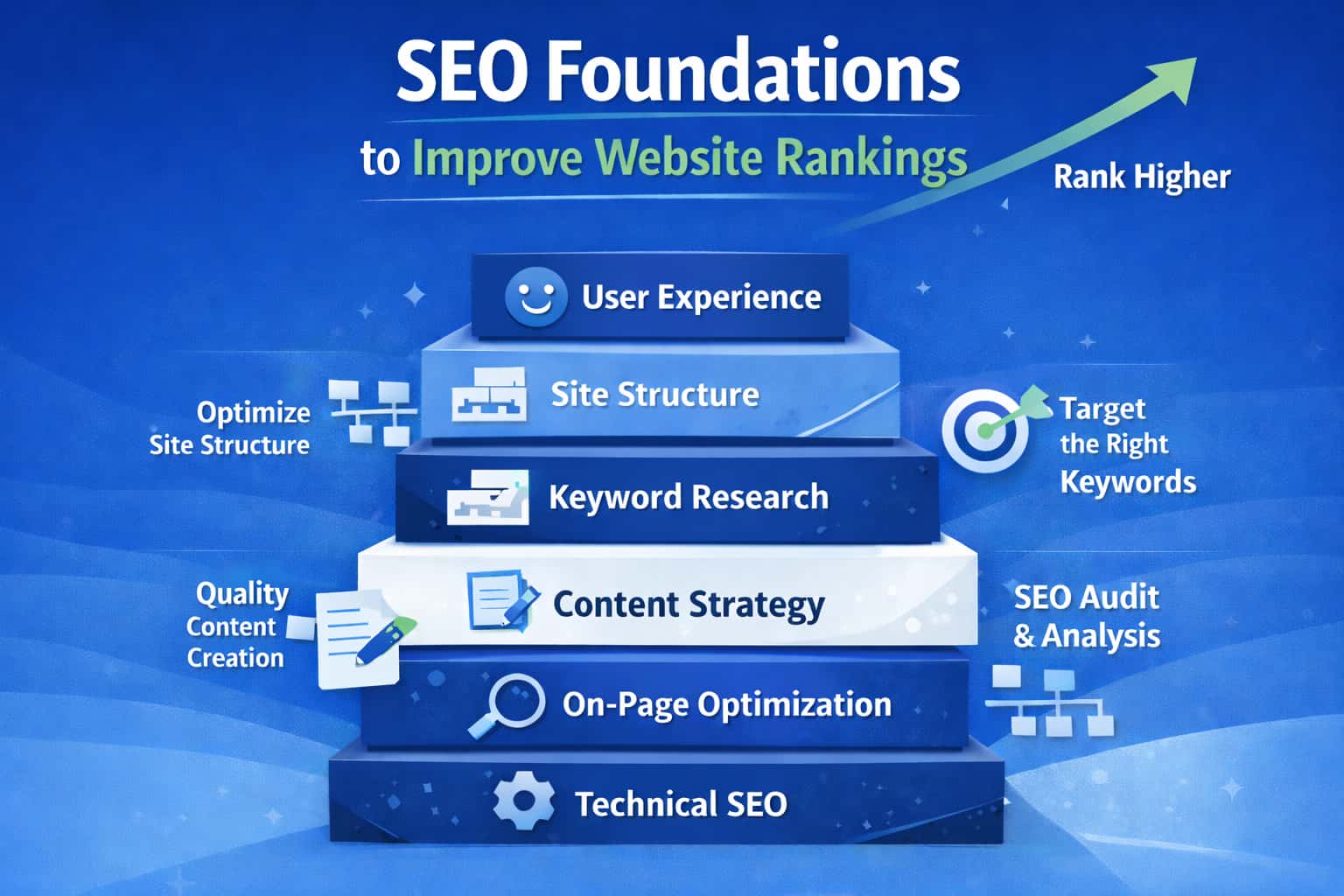
Instead of chasing quick fixes, the right approach is to build a strong SEO foundation step by step. This guide walks you through each step in the exact order it should be done to improve website rankings sustainably.
Step 1: Understand Why Your Website Is Not Ranking
Before fixing anything, you need clarity.
Common signs of poor SEO foundation:
Pages not appearing in Google search
Rankings stuck beyond page 2
Low or declining organic traffic
Content not ranking even after months
This usually points to issues in SEO structure, keyword targeting, or content relevance.
Goal of this step: Identify the real problem, not just the symptom.
Step 2: Perform a Complete Website SEO Audit
A website SEO audit gives you a clear picture of what’s working and what’s broken.
What to Check in an SEO Audit
Indexing and crawlability
Site speed and performance
Mobile friendliness
Broken links and errors
On-page SEO issues
Content quality gaps
A structured website SEO audit checklist prevents guesswork and helps you prioritize fixes.
Step 3: Fix Technical SEO Issues First
Technical SEO is the foundation everything else depends on. If this layer is weak, content and keywords won’t perform well.
Key Technical SEO Fixes
Ensure pages are indexed properly
Optimize site speed
Fix crawl errors
Use clean and readable URLs
Enable HTTPS
Submit XML sitemap
Why this matters: Search engines must be able to access, understand, and trust your site before ranking it.
Step 4: Align Your Website with Core SEO Ranking Factors
Search engines rank pages based on multiple SEO ranking factors, but a few fundamentals matter most.
Core Ranking Factors to Focus On
Content relevance to search intent
Page experience (speed, mobile, usability)
Internal linking structure
Keyword placement and context
Trust and authority signals
You don’t need to chase every algorithm update-focus on these consistently.
Step 5: Build a Clear SEO Content Strategy
One of the biggest reasons a website is not ranking is random content creation without strategy.
How to Build an SEO Content Strategy
Identify your target audience
Map keywords to specific pages
Create pillar pages and supporting content
Avoid keyword cannibalization
Maintain consistent publishing
A solid SEO content strategy helps Google understand your site’s topical authority.
Step 6: Optimize Existing Content (SEO Content Optimization)
New content won’t help if your existing pages are weak.
SEO Content Optimization Checklist
Improve titles and meta descriptions
Add clear H1, H2, H3 structure
Optimize internal links
Improve readability
Update outdated information
Add missing keywords naturally
Tip: Optimizing existing pages often brings faster ranking improvements than publishing new ones.
Step 7: Apply On-Page SEO Best Practices
On-page SEO helps search engines understand what each page is about.
On-Page SEO Essentials
One primary keyword per page
Natural keyword placement
Optimized URLs
Image alt text
Schema-ready content structure
Strong on-page SEO improves relevance and click-through rates.
Step 8: Strengthen Internal Linking and Website Structure
Internal linking connects your content and distributes SEO value across pages.
Best Internal Linking Practices
Link related pages contextually
Use meaningful anchor text
Avoid orphan pages
Support important pages with internal links
Avoid Common SEO Foundation Mistakes
Even good websites struggle because of these mistakes:
Targeting too many keywords on one page
Ignoring search intent
Publishing thin or duplicate content
Skipping regular SEO audits
Relying only on tools instead of analysis
Avoiding these protects long-term rankings.
Track Performance and Improve Continuously
SEO is not a one-time activity.
What to Track
Keyword rankings
Organic traffic
Index coverage
Click-through rates
Page performance
Use Google Search Console and Analytics to refine your strategy regularly.
Conclusion: Build SEO Step by Step for Lasting Rankings
Building strong SEO foundations is not just about rankings – it’s about creating a website that search engines can easily understand and users can confidently navigate.
If you’re planning to build or revamp your website, choosing an ensures your site is structured, optimized, and ready to rank from day one.
Explore our SEO-focused website development services to build a website designed for long-term visibility and growth.
FAQ's
Why is my website not ranking on Google?
Most websites fail to rank due to weak SEO foundations such as technical issues, poor keyword targeting, or lack of a clear SEO content strategy.
How long does it take to fix SEO ranking issues?
Initial improvements can be seen within 4–8 weeks, but consistent SEO work typically shows strong results over 3–6 months.
Is technical SEO more important than content?
Both are equally important. Technical SEO enables search engines to access content, while content quality determines relevance and rankings.
Can old websites also struggle with rankings?
Yes. Outdated structure, content decay, and ignored SEO updates often cause ranking drops in older websites.
How often should I run a website SEO audit?
A full SEO audit should be done every 3 months, with smaller checks monthly to catch issues early.
Does internal linking really affect SEO rankings?
Yes. Internal linking helps distribute authority, improves crawlability, and strengthens topical relevance.